Outcomes Intermediate › Unit 02 Feelings

Учебник

Уроки юнита 02 со страниц 14–19: тексты, иллюстрации и задания учебника. Задания с ответами в ключах проверяются автоматически.

Учебник, с. 14
02 Feelings

Vocabulary Feelings

A How are the people in the pictures feeling? Why? Can you use any of the words in the box to describe them?


exhaustedworriedfed upconfusedterriblerelaxedstressedin a good / bad moodupsetfuriousannoyeddisappointedpleaseddownguilty
Picture 1
Picture 2
Ответ (ключ)

Picture 1: The child could be exhausted, furious, upset, fed up, in a bad mood; the father could be stressed, furious, annoyed, in a bad mood; the mother could feel terrible, guilty, worried, stressed; the other people could be annoyed, fed up.

Picture 2: The man could be pleased, in a good mood, disappointed (but pretending to be pleased); the other people could be relaxed, pleased (and down, fed up if they wish they were retiring).

B Which of the words in A may show you are feeling: tired, ill, sad, happy, unsure, angry, or bad about something you did?

C Have you had any of these feelings recently? Why?

Grammar be, look, seem etc

Be, feel, look, seem, and sound are all linking verbs that can be followed directly by an adjective.

A Match 1–8 with the reasons a–h for the feelings.

  1. Are you OK? You look a bit stressed. →
  2. Are you all right? You look exhausted. →
  3. Is Julie OK? She sounded a bit disappointed. →
  4. Is Mike all right? He seems a bit down. →
  5. Are you OK? You look a bit ill. →
  6. Are you all right? You seem totally confused. →
  7. Have you seen Ann? She sounded so relaxed! →
  8. Hi. You look like you’re in a good mood. →
  1. Yeah, I’ve just found out I’ve got a new job. I’m really pleased.
  2. I am! My car broke down and I had to walk home.
  3. Yeah, I feel terrible. I think I’m going to throw up.
  4. I am. I’m really behind with work and I’ve got exams next week.
  5. Yeah, I don’t get this. What am I supposed to do?
  6. Yeah. I think the week in the spa really helped her.
  7. He’s just split up with Jo and he’s quite upset.
  8. Yeah. I think she expected to get a better mark as she’d studied so much.

B Write your own responses to 1–8. Practise in pairs.

▶ Need help? Read the grammar reference on p. 138

Language patterns

Write the sentences in your language. Translate them back into English. Compare your English to the original.

She expected to get a better mark.
I expected London to be more modern.
I didn’t expect to have so much homework.
We didn’t expect it to take so long.
We didn’t expect you to be so early.

Учебник, с. 15

Listening

You are going to hear two conversations. The first is between two people talking about their friend Karim. The second is between two women, Belinda and Alisha.

A ♪ 2.1 Listen. How do these people feel?

Conversation 1: Karim
Conversation 2: Belinda, Alisha

Ответ (ключ)
Karim: a bit down, worried, upset; Belinda: fed up, stressed; Alisha: great, pleased.

B Do you remember why they feel this way? Listen again and check.

Ответ (ключ)
Karim’s mother is ill; Belinda has to find somewhere new to live, Alisha has finished her exams.
♪ Аудиоскрипт 2.1 — R = Ryan, C = Clara · B = Belinda, A = Alisha (учебник, с. 160–161)
синтезатор речи браузера — аудиозаписей к учебнику в материалах нет
Conversation 1

R:Hey, Clara!

C:What is it, Ryan?

R:Have you seen Karim this week?

C:Yeah, I saw him yesterday. Why?

R:Is he OK? I haven’t spoken to him for a while, but the last time I saw him he seemed a bit down.

C:Hmm. I know. I think it’s his mum. Apparently, she’s quite ill and he’s just very worried about her.

R:Oh no. What’s wrong with her? Is it very serious?

C:I think it must be. He was quite upset when I spoke to him, and he didn’t want to say much.

R:Oh dear. That’s awful. I feel a bit guilty now that I haven’t rung him, because I had a feeling something was wrong.

C:Why?

R:Well, I met him outside the university with Chris. Chris and I were chatting, but Karim didn’t say much. In fact, he hardly said anything at all.

C:Really?

R:And Karim is normally really chatty.

C:I know. Well, he probably isn’t in the mood to talk to anyone at the moment.

R:Oh dear. Well, if you see him, tell him I’m thinking of him. Say ‘hello’ to him from me.

C:Sure.

Conversation 2

B:Hello Alisha! How’s it going?

A:Great actually, Belinda. I’ve just finished all my exams!

B:That must be a relief. How did they go?

A:Quite well, I think. I was really pleased with how I did.

B:That’s great.

A:Are you all right? You look a bit fed up.

B:Yeah, sorry. It’s not you. I’m just having a few problems with my accommodation.

A:Oh dear. What’s the problem?

B:Oh, I’ve just found out I can’t continue to stay where I am at the moment.

A:What a pain! How come?

B:I don’t really want to explain. Basically, I need to find something else and, to be honest, I just don’t need the stress.

A:I can imagine. Can I do anything to help?

B:No, it’s OK. I’m sure it’ll sort itself out, but thanks.

A:Well, at least let me buy you a drink.

B:OK. That’d be nice.

A:What would you like?

B:A cappuccino would be good.

A:Anything else? A bit of cake? Go on. It’ll cheer you up.

B:Well, I have to say that chocolate cake looks very nice.

A:I think I’ll join you – to celebrate finishing my exams.

Native speaker English

How come?

People often use How come? instead of Why?

A:I can’t come to your wedding, I’m afraid.B:Oh what a shame. How come?A:I’ve got an exam that day.

Speaking

A Work in pairs. Discuss these questions.

  • Do you find it easy to talk about your feelings? Who do you talk to if you have a problem?
  • What would you do or say if a friend was upset? Would it be different if it was a man or a woman?
  • What kind of things do you do to cheer yourself up?
  • Are you good at sorting out problems?

Developing conversations Response expressions

We use lots of short expressions to respond to news.

A Look at the following conversations and try to translate the expressions in bold. Are there any you cannot translate?

  1. A:I can’t drink at the moment. I’m pregnant.B:Really? Congratulations! When is the baby due?
  2. A:I’m going to Canada to study English.B:Wow, that’s great! How long are you going for?
  3. A:I’m afraid I can’t meet you tonight.B:Oh, what a shame! Are you sure?
  4. A:My brother’s not very well.B:Oh no! I’m really sorry. I hope it’s not too serious.
  5. A:I’ve lost my wallet.B:Oh no, what a pain! Did it have much in it?
  6. A:I’ve found my wallet!B:Phew, that’s a relief! Where was it?

Pronunciation Responding

With positive responses our voice goes higher.


With negative responses our voice goes lower.

A ♪ 2.2 Listen to the six responses from Developing conversations and copy the stress and intonation.

♪ Аудиоскрипт 2.2 — responses (учебник, с. 15)
синтезатор речи браузера — аудиозаписей к учебнику в материалах нет

B:Really? Congratulations!

B:Wow, that’s great!

B:Oh, what a shame!

B:Oh no! I’m really sorry.

B:Oh no, what a pain!

B:Phew, that’s a relief!

B Work in pairs. Practise 1–6 from Developing conversations. Try to continue them.

Conversation practice

A Work in pairs. Think of a piece of good or bad news. Write a conversation like the ones you heard in Listening. Include response expressions.

B Try to remember your conversation. Act it out in front of another pair of students.

Учебник, с. 16

Speaking

A Check you understand the words and expressions in bold. Then discuss the questions in groups.

  1. How often do you do these things? In what situations?
    • hug people
    • kiss people on the cheek or lips
    • walk arm in arm with people or hold hands
    • shake hands or bow
    • touch people on the arm or put your arm round their shoulder
  2. Do you do any of these things more often or less often than most people in your country? Why?
    I think I’m fairly typical. / I’m maybe a little bit unusual.
  3. Have you been anywhere where they do these things differently to you? Where? What do they do?

Reading

A Work in pairs. Look at the text It only takes Juan Mann to change the world! Discuss these questions.

  • What is the man doing in the pictures? Why?
  • What would you do if you saw someone like this?
  • Are any people like him famous in your local area / country? What for? How do people feel about them?

B Read and see if you feel differently about the man afterwards.

Today’s story
It Only Takes Juan Mann To Change The World!
Free hugs

In the modern world, it is not unusual for people to feel depressed or isolated. It can be hard to make meaningful connections with others. That was how ‘Juan Mann’ felt – until the day he decided to start giving free hugs. What started as a desperate attempt to change his own life has transformed him into an international star, thanks to the power of the Internet!

On returning to Sydney, Australia, in early 2004, after travelling in Europe, Mann had a miserable year in which his parents divorced and he found himself lonely and out of work. It was a depressing time. “I was alone. My family was elsewhere; my friends had all moved on. It was just me. It was just me, and I had to do something,” said the famous hugger, who goes by the name of Juan Mann (‘One man’), but who keeps his true identity secret.

“And I sat around for months doing nothing. Noticing, just watching the world. I didn’t have a lot of contact with people. I was just on my own. And I thought I would try to step out of that and try and do something different.”

And something different is exactly what he did! Mann went to one of Sydney’s main shopping districts holding a cardboard sign saying ‘Free Hugs’ – and waited. He expected to last an hour at the most and asked a friend to come along to protect him, and left his wallet at home.

After 15 minutes, however, a woman approached and told him that her dog had died that morning and that it was also the first anniversary of the death of her daughter, and that she really needed a hug. Mann was happy to help!

His ‘Free Hugs’ campaign continued quietly for a couple of years until a friend made a film of him and posted it on YouTube, the online video sharing site. Since then, it has been seen by over 14 million people and fans have started copying him. Last year, the video clip was named the most inspiring on the site.

Mann finds this funny because at school he was told that he did not have the social skills to do humanitarian work. Yet he now seems to be a therapist for a whole city’s problems.

“Every week a number of people will tell me their story, how they have suffered and how they get by, the mistakes they’ve made and the lessons they’ve learned,” he said. “I’m very fortunate in what I do in that I learn from everyone else’s mistakes as well as my own.”

Mann claims many people need someone to listen to their problems – but are too embarrassed to call a help line or get professional help.

Mann’s original plan was to personally take his campaign around the world, but he decided to stay in Sydney because “Now it all happens online.”

Mann is currently writing a book about his experiences and intends to carry on hugging people “until nobody wants me.” Until then, his message remains clear: have a hug. It will make you feel much better!

C Work in pairs. Discuss these questions. Then read the article again to check your answers.

  1. What made Juan Mann start his campaign?
  2. How did he feel when he went out the first time?
  3. Who first asked for a hug and why?
  4. How did Mann become so famous?
  5. Why does he feel surprised and lucky about what he does now?
  6. What is Mann’s theory about why people want hugs?
Ответы (ключ)
  1. He felt lonely and depressed and wanted to do something different.
  2. He felt rather pessimistic and vulnerable.
  3. A woman whose dog had died and for whom this was the anniversary of the death of her daughter.
  4. He became famous through the Internet site YouTube.
  5. He was told at school he could not do this kind of work; he learns from other people’s mistakes as well as his own.
  6. He thinks many people need someone to listen to and comfort them but are too embarrassed to ask a professional.

D Which adjectives went with these nouns?

  1. connections
  2. attempt
  3. star
  4. year
  5. identity
  6. skills
  7. help
  8. plan
Учебник, с. 17

Vocabulary Adjective collocations

A In the text, you read that 2004 was a depressing time for Juan Mann. Match these -ing adjectives with the nouns.

inspiringexcitingdisappointingannoyingconfusingrelaxing
  1. holiday / bath / atmosphere / place / time
  2. habit / person / noise / problem / spam
  3. city / new development / discovery / opportunity
  4. teacher / speech / story / book / film / video clip
  5. instructions / message / grammar / explanation
  6. response / news / loss / result / game / sales

B Write eight true sentences using the new collocations.

Grammar -ing / -ed adjectives

Some adjectives, including those ending in -ing, only describe things which cause a feeling:

The film was so boring that I fell asleep.


The -ed and other adjectives in Vocabulary exercise A on p. 14 describe people’s feelings:

I’m exhausted. I need to go to bed.

A Choose the correct word (in italics) in sentences 1–6 below.

  1. I’m . What did he say?
  2. This is really . I love Maths.
  3. I got a mark in my test.
  4. I’m so ! I can’t stand algebra!
  5. I hate being in my Dad’s class. He’s so !
  6. Why do I have to sit next to him? He’s so !

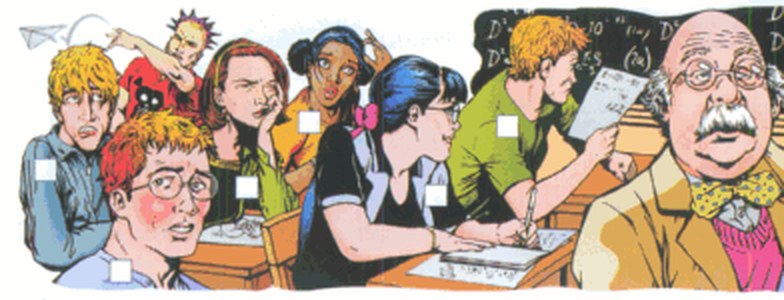
B Now match 1–6 to the pictures.

  1. I’m confused. What did he say? →
  2. This is really interesting. I love Maths. →
  3. I got a disappointing mark in my test. →
  4. I’m so bored! I can’t stand algebra! →
  5. I hate being in my Dad’s class. He’s so embarrassing! →
  6. Why do I have to sit next to him? He’s so scary! →

▶ Need help? Read the grammar reference on p. 138

Speaking

A Work in pairs. Discuss these questions.

  • Does your town or area have any similar problems to Sydney?
  • At one point the city council tried to stop Juan Mann’s free hugs campaign. Why do you think they did that?
  • Has your government tried to stop something popular? Why? Was it successful?
  • Can you think of any other news stories which have been spread through the Internet?
  • Have you ever posted anything on the Internet? What?
Учебник, с. 18

Listening

You are going to hear two friends talking. Sarah has just met Louise in front of a shop.

A What things do you think they will say? Have the conversation.

B ♪ 2.3 Listen. Do the adjectives in the box describe Sarah or Louise?

  1. annoyed →
  2. exhausted →
  3. happy →
  4. mysterious →
  5. shocked →
  6. stressed →

C Why are they annoyed, happy, being mysterious, etc.? Listen again if you need to.

Ответ (ключ)

Louise: stressed and exhausted because of working long hours; shocked when she hears Sarah’s going out with her boss (and when she sees him). B

Sarah: mysterious because she doesn’t want to talk a about her new boyfriend / boss; happy because she b loves her new job. Annoyed because people think she L got the job because of her relationship with the boss.

♪ Аудиоскрипт 2.3 — S = Sarah, L = Louise (учебник, с. 161)
синтезатор речи браузера — аудиозаписей к учебнику в материалах нет

S:Hello Louise!

L:Oh Sarah. All right.

S:How’s it going?

L:OK. I’m a bit stressed to be honest. I’m working quite hard at the moment. We’re finishing at nine most days!

S:Really? What a pain. You must be exhausted.

L:Yeah, I am. So what are you doing here? Are you window shopping?

S:What? No, no. Not really. I’m just meeting a friend here. I’m a bit early.

L:Oh right. Hey listen, Sarah. I’ve rung you a few times recently, but you always seem to have your phone switched off or you don’t answer it.

S:Oh right, yeah, Sorry about that.

L:So why aren’t you answering it? Don’t you want to talk to me?

S:No, no, it’s not that!

L:I mean, you usually answer it on the first ring!

S:I know, I know.

L:So what? Is it work?

S:Sort of.

L:What do you mean, ‘sort of’?

S:Well, if you must know, I’m seeing someone from work.

L:Oh right! But why are you being so mysterious about it? It’s unlike you. You normally tell me everything.

S:Well, it’s just ... well, it’s my boss!

L:You’re going out with your boss? So how long has this been happening?

S:About three weeks.

L:That’s not long.

S:No. That’s why I don’t want anyone to know for the moment. I’ve just changed jobs too.

L:Oh really? I didn’t know that. What are you doing now? Did you get promoted?

S:No, the new job isn’t really a promotion. I’m not getting any more money. I’m just doing something different. It’s more marketing than sales.

L:And you studied marketing, didn’t you?

S:Yeah, that’s right. I prefer marketing, so it’s a good change. I’m really enjoying it.

L:Well, with your boss, it sounds like you’re having a great time!

S:But I didn’t get the new job because of my boss. I was promoted by Head Office.

L:Oh right.

S:But you see, this is why I don’t want people to know about the relationship! They’ll think I’ve got the job because I’m going out with the boss. It’s really annoying.

L:OK, OK, I’m sorry. It was a stupid thing to say. Listen, what are you doing on Friday? Do you fancy meeting? It’d be nice to hear more of your news.

S:I’m afraid I can’t. I play badminton on Fridays. And this Friday we’re going for a meal afterwards.

L:Oh right. That’s a shame. Maybe next week sometime.

S:Yeah – yeah.

L:So ... when am I going to meet your boss?

S:Er...Um... er ... now. There – coming towards us.

L:Wait! That’s your boss!

Grammar Present continuous

A Write the missing words from Listening in the present continuous.

  1. I quite hard at the moment. We at nine most days!
  2. So what here? ?
  3. Not really. I a friend here. I’m a bit early.
  4. I someone from work.
  5. Why so mysterious about it? It’s unlike you. You normally tell me everything.
  6. I any more money or anything. I something different.
  7. What on Friday? Do you fancy meeting?
  8. I’m afraid I can’t. I play badminton on Fridays and this Friday for a meal afterwards.

B Work in pairs. Discuss the questions.

  1. Which examples of the present continuous in 1–8 in exercise A:
    1. show an action is temporary and / or unfinished?
    2. show something in the future that involves an arrangement with other people?
  2. Which sentence in exercise A uses the verb be in the present continuous form? Why?
Ответ (ключ)
1 a 1, 2, 5, 6 b 3, 4, 7, 8 8
2 5 – because being means behaving / acting in this
case →see grammar reference p. 138 D

▶ Need help? Read the grammar reference on p. 139

Grammar Present continuous / present simple questions

Double questions are very common in English. Notice these examples from Listening.


So what are you doing here? Are you window shopping?
What are you doing on Friday? Do you fancy meeting?

A Make double questions in the present continuous or present simple with the ideas in 1–8.

  1. How / your course / go? you / still / enjoy / it?
  2. What / you / do / now? you / fancy / going for a coffee?
  3. What / your sister / do / these days? she / still / study?
  4. you / work / this weekend? you / want / go for a picnic?
  5. I / need / a coat? it / still / raining outside?
  6. What / you / do here? you / work / near here?
  7. What / you / do? you / wait / to be served?
  8. What / be / the matter with her? Why / she / shout / me?

B Match the answers a–h with the questions 1–8 in exercise A.

  1. How is your course going? Are you still enjoying it? →
  2. What are you doing now? Do you fancy going for a coffee? →
  3. What is your sister doing these days? Is she still studying? →
  4. Are you working this weekend? Do you want to go for a picnic? →
  5. Do I need a coat? Is it still raining outside? →
  6. What are you doing here? Do you work near here? →
  7. What are you doing? Are you waiting to be served? →
  8. What is the matter with her? Why is she shouting at me? →
  1. I’m afraid so. I could meet you later today though, if you like.
  2. Yeah, it’s pouring down. I’ve got an umbrella, if you need one.
  3. I don’t know. She’s been in a bad mood all day. Just ignore her.
  4. Yeah, the assistant is just sorting out this lady’s problem.
  5. Sorry, I’m in a rush. My friend’s waiting for me.
  6. Yeah, she graduated last year, but now she’s doing a Masters.
  7. Yeah, although I’m finding it a lot harder than before.
  8. No, I’m just visiting a client. I’m just getting a sandwich before I go there.

C Work in pairs. Have conversations asking and answering 1–4 below. Add second questions to make double questions. Try to continue each conversation for as long as you can. For example:

A:What are you doing these days? Are you still studying?B:No, I’m working in a bank now. And what are you doing these days? Are you still teaching?A:Yes, but I’m not enjoying it!
  1. What are you doing these days?
  2. What are you doing here?
  3. What are you doing after the class?
  4. What’s the matter with him?
Учебник, с. 19

Developing conversations Making excuses

Look at the example from Listening. We often use the present simple or continuous to explain why we can’t or don’t want to do something.


A:What are you doing on Friday? Do you fancy meeting? It’d be nice to hear more of your news.B:I’m afraid I can’t. I play badminton on Fridays. or I’m going away for the weekend.

A Give reasons for refusing the following requests:

  1. A:Do you think you could help me with this?B:No, sorry, but I can’t. …
  2. A:We’re going out for dinner later. Would you like to join us?B:Oh, I’d love to, but I can’t. …
  3. A:Can I just check my email on your computer?B:No, sorry. …
  4. A:Do you really like this kind of music? Can I just turn it off?B:No, don’t! …
  5. A:This is rubbish! Is it OK if I change the channel?B:No, it’s not! …
  6. A:I was wondering if you wanted to go out somewhere with me on Friday?B:Oh, it’s nice of you to ask me, but I can’t. …

B Work in pairs. Take turns reading out the questions. Read your response and continue the conversation.

Speaking

A Look at the pictures below. Are they your idea of holiday heaven or of holiday hell? Why?

B Read the short text about other people’s ideas of heaven and hell. Work in pairs. Discuss which of the ideas you agree with. What is your favourite comment? Why?

C Write your own idea of heaven and hell. Explain why. Use language from this unit or the text such as:

verbs: love, annoy, hate, can’t stand, depress, bore, etc.
adjectives: relaxing, annoying, boring, fantastic, amazing, etc.

D Tell different students your ideas. Do they agree with you?

My idea of heaven is:

…having a long hot bath at the end of the day with candles and a glass of wine – it’s just so relaxing. Carla, 35, Scotland

…playing with my five-year-old son. It always puts me in a good mood. Hamid, 28, Morocco

…driving round in my sports car in the summer with the roof down and the Rolling Stones playing on the CD. I love it. Brad, 49, Australia

…being stuck in a lift with Brad Pitt. Patricia, 23, Mexico

…having a barbecue with my family. Zeynep, 14, Turkey

…being in a quiet room with a good book. Shirley, 67, England

…scoring the winning goal at football. It’s the best feeling ever. Pavel, 13, Czech Republic

…going skiing. It’s exciting. You’re in amazing scenery, and it’s fantastic! In-ha, 20, South Korea

My idea of hell is:

…having to drive anywhere. I hate it! And other drivers just annoy me. Joan Carles, 43, Spain

…sunbathing on a beach. I can’t stand the heat and I find it incredibly boring. Frank, 19, Germany

…looking after my baby brother. He’s so annoying. Celine, 15, France

…watching the news. It depresses me too much! Concha, 21, Peru

…walking anywhere with my parents. I can’t stand it. We never go anywhere interesting. Daffyd, 10, Wales

…being stuck in a lift with any politician. Imagine, a boring situation with someone who bores you! Sofia, 19, Italy

…taking an exam. I get so nervous. It’s awful. Cissy, 17, Hong Kong