Outcomes Intermediate › Unit 03 Time off

Учебник

Уроки юнита 03 со страниц 20–25 (и тексты для ролевой игры со с. 156–158). Задания с ответами в ключах проверяются автоматически.

Учебник, с. 20
03 Time off

Speaking

A Work in pairs. Discuss the question.

What are the main tourist attractions locally / regionally / nationally?

Vocabulary Places of interest

A Complete the sentences with the words in the boxes.

gallerieslakemarketpalacesquare
  1. There’s a huge about ten miles outside of town, which is a great place to go fishing.
  2. There’s a great street out in the east of the city.
  3. There are lots of nice cafés and restaurants in the main .
  4. There’s an old royal down by the river. They were restoring it for years and they’ve just reopened it.
  5. It’s a very cultural city. There are lots of great museums and there.
old towncastlemosqueruinstheme park
  1. There’s an incredible there, where the Royal Family spend their holidays.
  2. There’s a really fun down by the beach. They’ve got some great rides there.
  3. There are some historic buildings in the .
  4. There are lots of ancient to go and see all along the coast.
  5. There’s a beautiful near here. You’ll hear the call to prayer in the morning.

B Complete the expressions with prepositions from exercise A.

  1. about ten miles / sixty kilometres / an hour of town
  2. in the west of the city / desert / country
  3. by the river / beach / lake
  4. all the coast / river / canal

C Think of five towns / cities / areas in your country that contain places of interest. Choose language from exercises A and B to describe the places of interest. Then work in pairs. Have conversations like this:

A:Have you ever been to …?B:No, never. What’s it like?A:Oh, it’s great. There are some / lots of amazing … there. There’s a / an incredible / great … there.B:Oh really? It sounds great.
Учебник, с. 21

Listening

You are going to hear a conversation between a tourist and a hotel receptionist in Kraków, Poland.

A Look at the places to visit in and around the city. Work in pairs. Decide which you would go and see and why.

Kraków

Rynek Glowny
The main market square in Kraków – a huge medieval square in the centre of the old town.

Full-day tour to Auschwitz-Birkenau Museum
Auschwitz-Birkenau was a Nazi concentration camp, where over a million Jews were killed during World War II.

Half-day tour to Wieliczka Salt Mine
These ancient mines are now a World Heritage Site.

Full-day tour to the Tatras mountains
Enjoy a day’s walking in this beautiful location.

Tour of Nowa Huta
Visit the old Communist housing district built during Stalin’s time.

Alchemia
Great local bar/club with live music six nights a week.

Kazimierz
The old Jewish district, now a lively area with excellent nightlife.

St. Mary’s Church
The city’s most important church, built in the sixteenth century.

B ♪ 3.1 Listen. Which of the things in Kraków are discussed? What does the tourist, Claire, decide to do? Work in pairs and compare your ideas.

Ответ (ключ)

Discussed: St Mary’s Church, Auschwitz, Kazimierz, Nowa Huta.

Claire decides to take the 2 o’clock tour of Nowa Huta.

C Complete the sentences. Then listen again to check your answers.

  1. I if you can help me.
  2. I’m of going sightseeing today.
  3. Can you anywhere good to go?
  4. It depends you like.
  5. I’m not really a big of churches, to be honest.
  6. Well, in that case, you try Kazimierz.
  7. a guided tour of Nowa Huta?
  8. I can call and a for you, if you want.
♪ Аудиоскрипт 3.1 — C = Claire, R = receptionist (учебник, с. 161–162)
синтезатор речи браузера — аудиозаписей к учебнику в материалах нет

C:Hello there. I wonder if you can help me. I’m thinking of going sightseeing somewhere today. Can you recommend anywhere good to go?

R:Well, it depends on what you like. There are lots of places to choose from. What kinds of things are you interested in?

C:I don’t know. Erm ... something cultural.

R:Oh right. OK. Well, quite close to here is St. Mary’s Church. It’s Kraków’s most famous church – and very beautifully decorated. You can walk there in five or ten minutes.

C:OK. I’m not really a big fan of churches, to be honest.

R:That’s OK. I understand. Of course, the most visited place near here is Auschwitz. There’s a day tour leaving soon.

C:Actually, we’re planning on going there later in the week.

R:Well, in that case, you could try Kazimierz, the old Jewish Quarter, where Steven Spielberg filmed some of Schindler’s List. It’s actually quite a lively area now. There are lots of good bars and restaurants round there.

C:Oh, so that might be nice for this evening, then.

R:Yes, maybe. Let me know if you want more information about places to eat or drink there. Erm... Then, if you’d prefer something a bit different, how about a guided tour of Nowa Huta – the old communist district? They’ll show you what life was like in the old days there.

C:Oh, that sounds interesting. How much is that?

R:About €40. I can call and book a place for you, if you want.

C:What times does that leave?

R:Every two hours from outside the hotel – and the tours last around 90 minutes. They leave at 10 o’clock, 12 o’clock, 2 o’clock and 4 o’clock.

C:OK, that’s great. Can you book me onto the 2 o’clock tour? Then I can do some shopping in the main square in town beforehand.

R:Sure.

Developing conversations Recommendations

A Put the two conversations into the correct order.

Well, you could try Oxford Street. There are lots of big department stores there.
Oh, OK. Well, in that case, how about Portobello Road? It’s a big street market. You can find lots of bargains there.
To be honest, I’m not really a big fan of department stores.
Oh, that sounds great. I love that kind of thing. Is it easy to get to?
1 I’m thinking of doing some shopping today. Can you recommend anywhere?
Yes, very. Here. I’ll show you on the map.

Right. I’m not really into museums, to be honest.
Well, you could try the local museum. That’s quite close to here. They’ve got lots of interesting things in there.
No, it’s quite cheap. It should only be about $10.
I’m thinking of doing some sightseeing today. Can you recommend anywhere?
Oh, that sounds better. Is it expensive to get into?
That’s OK. In that case, how about going to the Roman ruins down by the lake? There are also some nice cafés and you can swim there.

B Work in pairs. Practise reading the conversations.

Conversation practice

A Work in pairs. Role-play a conversation between a tourist and a hotel receptionist in the place where you live. When you have finished, change roles and start again.

Student A: you are the tourist. You are thinking of going sightseeing. Ask for recommendations. Reject some before deciding on one.

Student B: you are the hotel receptionist. Suggest some different places to the tourist. Explain why they are good.

Учебник, с. 22

Vocabulary Holiday problems

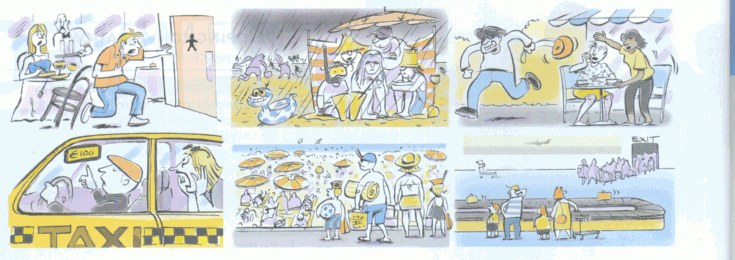
A What problems are the people having in each of the pictures?

B Complete the sentences with the pairs of words from the box.

arguing + angrystole + spoiltstuck + hourscrowded + spaceupset + threw uppoured + windyripped off + chargedmissed + lost
  1. Our flight was delayed so we our connecting flight. Then they our luggage.
  2. Two days before we left, we got robbed. Someone my bag with my camera, purse and passport. We’d actually had a lovely time up till then, but that rather the holiday.
  3. The beach was always really . You could hardly find a to put your towel.
  4. The weather was awful. It with rain most of the time and it was really as well.
  5. I don’t know if it was the food or the water, but I had a really bad stomach. I was in and out of the toilet for three days and I twice.
  6. We got a couple of times. In one restaurant, they €20 for a salad.
  7. My sisters didn’t stop with each other the whole time we were away, and then my parents got with them. It was a nightmare!
  8. There was an accident on the motorway. We were in a traffic jam for .

C Have any of these things happened to you? When?

Reading

You are going to read an article about public holidays and workers’ holiday entitlement in different countries. Note that public holidays are known as bank holidays in the UK.

A Work in pairs. Discuss these questions.

  • How many public holidays are there where you live? Do you take all of them?
  • What is your favourite public holiday? Are there any you do not like? Why?
  • What did you do on the last public holiday?

B Read these Holiday facts. Is there anything you find surprising? Why?

Holiday facts

  • The legal minimum holiday entitlement in the EU is 20 days per year, excluding weekends.
  • The UK only gets eight public holidays a year, compared to a European average of 10.8.
  • Slovenia has the most public holidays in the EU with 16.
  • UK workers have no legal right to have public holidays.
  • Germany takes the most time off on average at 43 days a year, with Finland next on 39.
  • Japan actually allows 17.5 days per year, but on average workers only take 9.

Workers Can’t Bank on Holidays

The August bank holiday is here again. The busiest weekend of the year will see millions of people get stuck in traffic on the motorway; bored children ask, “Are we there yet?”; delays at airports and accidents on the roads. Hundreds of people will get sunburnt on crowded beaches; children will throw up after eating too much ice cream; adults will drink too much beer; families will argue and kids will scream “It’s not fair!” Then it’s home: more traffic jams, more delays, more arguments.

You might think that anyone who is going to miss this annual horror show is lucky. However, British trade unions are using this weekend to highlight the low number of public holidays in Britain compared to the rest of Europe. They also want to draw attention to the fact that a large number of workers are not getting their legal entitlement of twenty days’ holiday per year.

A trade union spokesman said yesterday, “British workers get fewer public holidays than workers in any other European country, and the government also allows companies to include those eight days within the compulsory 20. British workers are being ripped off and it needs to change.” The unions want the government to start by declaring three new public holidays. Britain has just eight public holidays compared to 16 in Slovenia.

The unions also say there is a worrying trend for some workers not to take their full entitlement to holiday because they have too much work. In Japan, lack of holidays has been linked to the problem of karoshi: dying from overworking.

While Britain and Japan may want more, other countries are debating whether to reduce the number of holidays. France cancelled one holiday in May to help pay for the care of old people. In Puerto Rico, businesses have complained that the high number of holidays – government workers take twenty-one – is damaging the economy. They argue they increase costs, raise unemployment, and mean higher prices for everyone.

C Now read the article. Answer these questions.

  1. Why does the writer refer to the August bank holiday as an ‘annual horror show’?
  2. What are the unions complaining about?
  3. What changes do the unions want?
  4. What is karoshi and why is it mentioned?
  5. What problems are caused by the high number of public holidays in Puerto Rico?
Ответы (ключ)
  1. Because it is the busiest weekend of the year and there are problems: traffic, delays, overcrowding and stress / arguments.
  2. Unions are complaining that there are not enough public holidays in the UK, compared with other countries and that many workers are not getting their legal holiday entitlement.
  3. The Union wants the government to declare three new public holidays.
  4. Karoshi is Japanese for dying from overwork. It is mentioned because many Japanese workers do not take their full holiday entitlement because they have too much work on.
  5. The high number of holidays in Puerto Rico cause higher costs, higher unemployment and higher prices, according to businesses.

D Work in pairs. What do these numbers in the article refer to?

  1. millions →
  2. 20 →
  3. 16 →
  4. hundreds →
  5. eight →
  6. one →
  7. three →
  8. twenty-one →

E Work in small groups. Discuss these questions.

  • Do you think the union is right? Why? / Why not?
  • Do you think your country needs more public holidays? Why? / Why not?
Учебник, с. 23

Speaking

You are going to read different people’s experiences of the issues in the article.

A Work in groups of three. Student A, read about Maggie on p. 156. Student B, read about Luca on p. 157. Student C, read about Ethan on p. 158.

Student A: Maggie (p. 156)

Information files, p. 156

You are Maggie, a personal assistant (PA) from the UK. Read about your holidays and then discuss them with the other students. Answer the questions on p. 23.

I do take my full entitlement, but the problem is trying to get time off as a family all together. I have 20 days. My husband has a better job than me and he gets 30 days off, but my children have over ten weeks throughout the year. Most of the time, my husband has to take time off at a different time to me so we can look after them. The other thing is the prices of flights always go up in the school holidays, and so we can’t afford to go away unless we go before the official holiday starts. The last time was three years ago. We went to Disney World in Florida, but the school complained about the kids missing classes.

Student B: Luca (p. 157)

Information files, p. 157

You are Luca, a civil servant from Italy. Read about your holidays and then discuss them with the other students. Answer the questions on p. 23.

As well as some breaks during the year, we always take the whole of August off. It’s an Italian tradition. We usually go to the seaside. We meet the same people: eat, enjoy some good wine, go to the beach, play tennis – just totally relax. There has been some talk about stopping people taking such long holidays. I have heard some businessmen in Italy say they can’t get anything done or that it’s expensive. I think this is just an American idea of work. It’s bad. Life is not all about work.

Student C: Ethan (p. 158)

Information files, p. 158

You are Ethan, a marketing manager from the United States. Read about your holidays and then discuss them with the other students. Answer the questions on p. 23.

I don’t take all the holiday I could. Back in the States, I worked for the same company that I’m working for now and took ten days a year. As a result, it’s quite strange for me to suddenly get more than twice that, just because I’m working in London at the moment. I do take more than ten days, though! I want to take advantage of my time in Europe. A couple of weeks ago, we went on a one-week tour of Italy and Austria. It was wonderful. We went to Rome, Florence, Pisa, Sienna, Venice, Milan, Salzburg, Innsbruck and Vienna.

Don’t look back at the texts. Role-play a conversation asking and answering these questions.

  • What do you do?
  • How much holiday do you get per year?
  • Is that the same for everyone in the UK / Italy / the US? Are you happy with what you get now?
  • Have you been away on holiday recently? Where did you go?

B When you finish, discuss these questions.

  • Is it OK to miss school to go on holiday?
  • Whose last holiday was the best: Maggie’s, Luca’s or Ethan’s? Why?
  • Which of the three people is most like you?

Grammar Present perfect questions

Look at this possible exchange from the role-play in Speaking.


A:Have you been away on holiday recently?B:Yes, I went camping in Tuscany. Have you ever been there?A:No, never. What’s it like?

To ask about general experiences before now, we often use the present perfect simple. Don’t just give a Yes or No answer – add a comment.

A Add Yes or No, never to the front of the following answers to the question Have you (ever) been to X?

  1. …… What’s it like?
  2. …… It’s supposed to be amazing.
  3. …… Several times.
  4. …… I’ve never really fancied it.
  5. …… I’d love to, though.
  6. …… It’s great. You should go.
  7. …… I wouldn’t go there, if I were you. It’s not worth it.
  8. …… … but I’m actually going to go there this summer.
  9. …… Have you? I’ve heard it’s quite nice.

Ответов к этому заданию в ключах нет.

▶ Need help? Read the grammar reference on p. 140

B Think of six places you have been to for which you would give the answers in exercise A. Write only the names of the places on a clean piece of paper.

C Work in pairs. Swap your piece of paper with a partner. Ask ‘Have you been to …’ questions about the places on your partner’s list.

Учебник, с. 24

Vocabulary Weather

A Match the sentence halves.

  1. It said it’ll be hot and humid during the day, and so …
  2. They said it’s going to be really windy, so …
  3. Apparently, it’s going to be really sunny, so …
  4. They said it’s going to be freezing and …
  5. They said it’s going to be boiling hot all week and …
  6. Apparently, it’s going to pour down tomorrow, so …
  7. They said it’s going to be generally quite warm, but …
  8. The same as today: grey, cloudy, cold, but …
  1. it might drop to minus 10°.
  2. on Tuesday it might reach 36°. I hate the heat!
  3. there might possibly be a storm this evening.
  4. we should take down the parasol or it’ll blow away.
  5. I’ll probably stay at home and keep out of the rain!
  6. hopefully I might get a bit of a suntan!
  7. they said it might clear up next week!
  8. it might be a bit chilly, especially at night.

B Spend two minutes memorising the sentence endings in exercise A. Then work in pairs.

Student A: say 1–8
Student B: close your book and say the endings.

C Work in pairs. Discuss these questions:

  • Do you know what the forecast is for tomorrow / the weekend / next week?
  • Are there any bad times to visit where you live because of the weather? Why? And when is the best time to visit?
  • How many of the different kinds of weather in exercise A have you had in the last year?

Listening

You are going to hear two English people discussing their plans for the coming Easter holiday. They also talk about the weather in Italy and the UK.

A Before you listen, work in pairs. Discuss why the people might describe the weather as annoying or worrying.

Ответ (ключ)

Andrew said it was worrying – probably because it is unnatural for the weather to be so hot at this time of year (Easter) and this is probably the result of global warming.

Cristina said it was annoying because she is going to miss it. She will be in Italy where the forecast is not good.

B ♪ 3.2 Now listen and complete the table.

CristinaAndrew
Plans
Weather
Ответ (ключ)
CristinaAndrew
PlansItaly, Sicily, holiday, beach, suntan, village on coast, PalermoWork, lunch with parents, picnic, beach
WeatherPour down, wet.Hot, sunny, 27 degrees
♪ Аудиоскрипт 3.2 — C = Cristina, A = Andrew (учебник, с. 162)
синтезатор речи браузера — аудиозаписей к учебнику в материалах нет

C:Oh don’t believe it!

A:What’s up?

C:I’m just checking the weather forecast for next week!

A:Oh right. Is it going to be bad?

C:Well, not here, it’s not. Apparently, it’s going to be boiling here: 27 degrees on Monday!

A:Really? That’s great!

C:Great for you, but I’m not going to be here. I’ve got a week off work. I’m going to Italy and apparently it’s going to pour down most of the week!

A:Oh dear. I forgot you were going away. Whereabouts are you going?

C:Sicily. I mean, it’s in the south! It’s supposed to be really sunny at this time of year. I was hoping to go to the beach and get a suntan, you know.

A:Oh no. Well, it’ll probably clear up later in the week. It’s not going to be wet for long.

C:I hope not, because I don’t think there’ll be much to do there.

A:Why? Where are you staying?

C:Some little village on the coast. We’re also thinking of going to Palermo for a couple of days. It depends on the weather.

A:Well, maybe you could go to Palermo first. There’ll probably be museums you could visit if it’s wet.

C:I suppose so. I prefer the beach, though.

A:Oh, OK. Well, maybe the forecast will be wrong and it’ll turn out really sunny.

C:Mmm. So what are you doing over the Easter holiday? Have you got any plans?

A:Well, I’ve got to work on Saturday, and I’m having lunch with my parents on Sunday, but apart from that ... I don’t know. I don’t usually do much on bank holidays, but if it’s going to be hot, l might go for a picnic in the park. I might even go to the beach. I guess it depends what time I get up on Monday! But honestly – 27 degrees! That’s mad for this time of year! It’s actually a little bit worrying, really.

C:Or annoying!

Language patterns

Write the sentences in your language. Translate them back into English. Compare your English to the original.

It depends on the weather.
It depends (on) whether it’s raining (or not).
It depends (on) how much it costs.
It depends (on) how far it is to walk.
It depends (on) how long it’ll take.
It depends (on) what time I get up.

Speaking

A Work in pairs. Discuss the question.

What is the most important thing for you when choosing a holiday? Why?

  • the countryside
  • being near a beach or a pool
  • the nightlife
  • guaranteed good weather
  • the local sights
  • peace and quiet
  • the history
  • the food
Учебник, с. 25

Grammar The future

A We use lots of different forms to talk about the future. How many do you know?

B Match the structures 1–7 from Listening with a–d below. Some structures match more than once.

  1. I’m not going to be here. →
  2. I’ve got a week off work. →
  3. It’ll probably clear up later. →
  4. We’re thinking of going to Palermo. →
  5. I’ve got to work. →
  6. I’m having lunch with my parents. →
  7. I might go for a picnic in the park. →
  1. Something which is definite / planned / organised.
  2. Something which is uncertain / unplanned.
  3. An obligation.
  4. Only a 50% certainty.

▶ Need help? Read the grammar reference on p. 141

C Complete the conversations with the words in the box.

going to’llthinkingmightmeeting’s got’ve got tomight
A:Are you going away in the summer?B:Probably, but we’re 1 of leaving it to the last minute to book, and trying to get some cheap package deal to Greece or somewhere like that. What about you?A:Not abroad. We2 probably just go to my parents’ in Scotland at some point. I suppose we 3 go camping if the weather’s OK, but it really depends on my wife. She’s not a big fan of camping.
A:Have you got any plans for the weekend?B:Yeah, I’m probably 4 a friend on Sunday, but I’m waiting for him to confirm. He5 an exam next week, so he 6 have to study on Sunday – it depends how much he gets done on Saturday. Anyway, he is 7 ring me at some point on Saturday evening to confirm. Why? What about you?A:Well, unfortunately, I8 do some shopping at some point, as I’ve got nothing in the fridge. Apart from that, no plans at all.B:Well, we could meet up on Saturday, if you like.

Native speaker English

at some point

If you do something at some point, you do it at one moment, but you do not know when exactly.

I need to go to the bank at some point today.
I’ll definitely see him at some point this week.
We went the wrong way at some point and got completely lost.

D Work in pairs. Discuss these questions.

  • Are you going away in the summer?
  • Have you got any plans for the weekend?
  • What are you doing after the class?
  • Are you going to do anything for your birthday?
  • Are you going to continue studying English after this course?
  • What are you going to do after you leave school / graduate?
  • Have you got any plans to change jobs?

Speaking

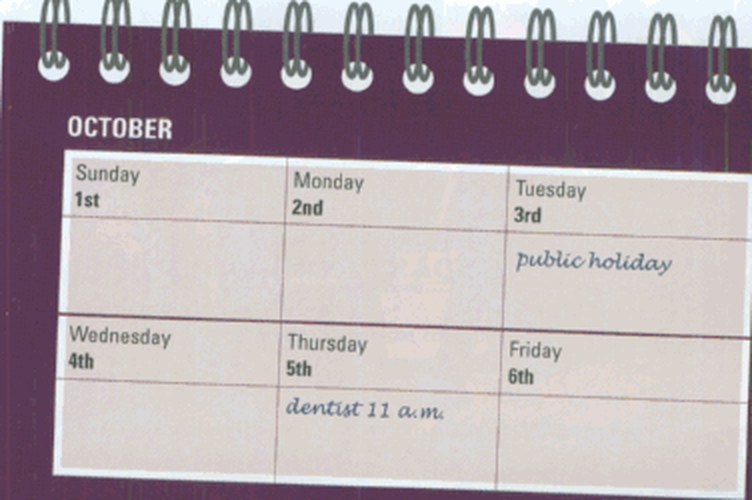
A Look at the calendar at the bottom of the page.

There is a public holiday on the Tuesday. You also have three days annual holiday till the end of the year, so you could take more time off if you want. It might rain on Saturday or Sunday and be a bit chilly, but it is going to clear up and get hotter during the week. Write in the calendar:

  • two nice things you are going to do
  • one other appointment.
  • one thing you have got to do.

Think about other things you might possibly do and when.

B Work in pairs. Role-play a conversation. Try to arrange to do something together during the week. In the conversation, try to use some of the language you have learnt in this unit. Start by asking: So what are you doing …?

October calendar